

A residential acquisition underwriting guide is not a spreadsheet exercise. It is the investment committee’s first line of defense against paying for a narrative instead of an asset. In prime residential value-add strategies, the difference between a compelling opportunity and an avoidable loss is often decided before the purchase agreement is signed: at the moment basis, scope, liquidity, and legal control are tested against reality.
Contents
For sophisticated capital, underwriting must answer a narrower and more consequential question than whether a property can appreciate: can this specific asset be acquired, repositioned, and monetized within a defined holding period while preserving downside discipline? That requires a controlled view of the entire operating cycle, from off-market sourcing through disposition.
What Institutional Residential Underwriting Must Prove
Residential acquisitions in Miami and across Florida can appear deceptively simple. Comparable sales are visible, demand narratives are abundant, and renovation costs can be modeled quickly. Yet institutional underwriting does not rely on surface-level comparables or broker guidance alone. It establishes whether the projected outcome remains acceptable after execution friction, market variance, and transaction costs are applied.
The underwriting file should prove four propositions. First, the entry basis is protected by a measurable discount to a credible stabilized or exit value. Second, the rehabilitation scope can be completed on time and with enforceable cost control. Third, the exit has sufficient liquidity under more than one market condition. Fourth, the ownership structure, title, insurance, tax treatment, and reporting architecture permit the investment to proceed without concealed legal or operational exposure.
This framework matters particularly in short-duration residential strategies. A five- to six-month monetization objective leaves little room for a weak contractor, an unresolved permit condition, or a comparability set that was optimistic from the beginning. Speed can enhance capital efficiency, but only when it is earned through preparation.
Residential Acquisition Underwriting Guide: Start With Basis
Basis is the capital at risk before the asset creates any value. It includes more than the purchase price. A complete all-in basis accounts for closing expenses, transfer and recording costs, insurance, property taxes, holding costs, financing where applicable, construction, contingency, sales costs, and the cost of time.
The central discipline is to separate the observed value of the property today from the value that is merely hoped for after execution. An acquisition team should build its exit valuation from closed, relevant transactions, then test those transactions for date, condition, micro-location, lot characteristics, buyer profile, and actual concessions. A renovated property one neighborhood away may not be a valid benchmark if its school district, waterfront access, flood exposure, or architectural quality appeals to a different buyer pool.
Underwriting should also distinguish between an average comparable value and a defensible liquidation value. The latter assumes that the asset must sell within the planned window without requiring an exceptional buyer or unusually favorable market momentum. This is where institutional discipline becomes visible: a lower exit assumption may reject more deals, but it protects capital from the habit of underwriting appreciation as operating performance.
A practical model uses at least three valuation cases: base, downside, and constrained-liquidity. The constrained-liquidity case is particularly relevant for high-value residences, where the buyer universe can narrow abruptly. If the investment only works under the most favorable case, the basis is not sufficiently protected.
Underwrite the Scope, Not the Mood Board
Value-add residential execution is frequently mispriced because the renovation estimate reflects aspiration rather than a property-specific scope. A credible budget begins with detailed inspections and contractor input before capital is committed. It identifies structural issues, roof condition, mechanical systems, electrical capacity, plumbing, windows, drainage, mold, environmental concerns, and permit dependencies.
The underwriting team should classify each expenditure by necessity. Life-safety and code-related repairs are non-discretionary. Functional improvements affect marketability and may be necessary to reach the projected buyer profile. Aesthetic upgrades can create differentiation, but they must be calibrated to the neighborhood’s price ceiling. Over-improving is not sophistication. It is a failure to match capital deployment to the exit market.
Contingency should be explicit, not buried in a broad construction line. Its appropriate level depends on asset age, inspection quality, scope complexity, and permit exposure. A recently built condominium with cosmetic repositioning carries a different risk profile than an older single-family residence with deferred maintenance and potential structural work.
Time belongs in the construction budget as well. Each additional week affects carrying costs, selling seasonality, project management capacity, and capital velocity. A low-cost contractor who cannot mobilize predictably may be more expensive than a higher-cost operator with reliable scheduling, insurance, supervision, and documented change-order controls.
The permit and insurance question
Florida underwriting requires a precise view of permits and insurability. Permit history can reveal unclosed work, unpermitted additions, or construction that may complicate resale. Insurance quotes must be obtained early enough to affect the acquisition decision, especially where wind, flood, roof age, or location alter coverage availability and premium assumptions.
These are not administrative details. They influence both carrying costs and exitability. An asset that cannot be insured on acceptable terms may face a narrower buyer pool and weaker financing support at disposition.

Accredited investors
Residential acquisition underwriting: test it against your own mandate
We walk accredited investors through how ARCSA Capital approaches residential acquisition underwriting in practice: entry basis, works period, exit window and governance, with your own allocation policy on the table. No generic deck.
Request informationOr receive the ARCSA Capital investment thesis by email, with the entry, stabilisation and exit assumptions behind the strategy:
General information for educational purposes. Not an offer to sell or a solicitation of an offer to buy securities, nor investment, legal or tax advice.
Treat the Exit as a Separate Underwriting Event
A common error is to model the exit as a percentage appreciation applied to the purchase price plus renovation. Institutional underwriting treats disposition as its own transaction, with its own costs, timing, buyer behavior, and evidence requirements.
The exit plan should identify the likely buyer, the relevant price band, the competing inventory, and the expected sale process. A primary residence buyer may value design, school access, privacy, and turn-key condition differently from an investor or second-home buyer. The property must be repositioned for the buyer who will actually transact, not for an abstract median buyer.
Days on market should be tested against current inventory and absorption rather than historical averages alone. If comparable listings are accumulating or undergoing price reductions, the model should assume a longer sale period or a lower pricing threshold. The appropriate response is not always to walk away. Sometimes the acquisition price can be renegotiated, the scope can be reduced, or the holding plan can be adjusted. The point is that every adjustment must be conscious and documented.
Exit costs also deserve discipline. Brokerage fees, staging, photography, repairs following inspection, seller concessions, transfer costs, and potential price adjustments are real components of the return calculation. Underestimating them can make a thin projected margin look institutional when it is not.
Governance Is Part of the Underwriting
For private capital, the investment case is incomplete without a governance case. The file should establish clear authority over acquisition approval, budget changes, related-party relationships, disposition decisions, and material deviations from the original plan. It should also preserve a traceable record of diligence, valuation evidence, contracts, and approvals.
This is especially relevant for cross-border investors and institutional Limited Partners who require visibility into how capital is deployed in the United States. Legal entity design, tax reporting, investor eligibility, AML controls, title review, and audit-ready recordkeeping are not peripheral services. They form the architecture that allows an asset-level strategy to be administered at institutional standard.
At ARCSA Capital, this discipline is designed around control of the full investment cycle: sourcing, diligence, acquisition, rehabilitation, and monetization. The objective is not to chase volume. It is to select transactions where operational visibility and legal structure are commensurate with the capital being entrusted.
Build a Decision Memo That Can Survive Scrutiny
The final investment memorandum should be concise enough for a decision-maker to evaluate quickly, yet rigorous enough to withstand later review. It should state the investment thesis, all-in basis, exit assumptions, renovation scope, principal risks, downside case, timing, liquidity plan, and approval conditions.
Most importantly, it should identify what would cause the firm to decline the acquisition. That may include an insufficient discount to downside value, unresolved title issues, contractor uncertainty, adverse insurance terms, unverified permits, or an exit dependent on aggressive price growth. A disciplined no is often more valuable than a marginal yes.
The best residential acquisitions are rarely the ones with the most attractive brochure. They are the assets whose numbers remain coherent after optimism has been removed, whose risks are visible before capital is committed, and whose exit has been planned with the same precision as the purchase. That is the standard a serious underwriting process should protect.
Key takeaways on residential acquisition underwriting
The points below condense this residential acquisition underwriting guide into a short reference that an investment committee can use when it reviews a sponsor’s file.
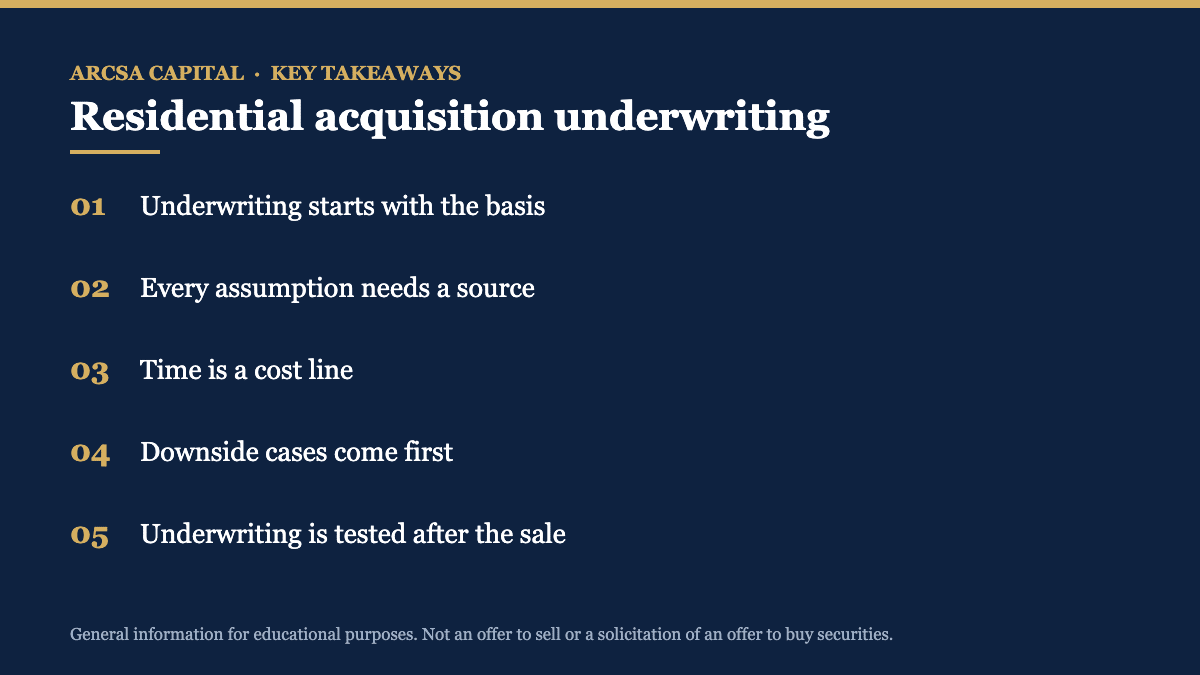
- Underwriting starts with the basis. The purchase price, closing costs and works budget define the margin of safety. If the underwriting only works at an optimistic resale price, the basis is wrong, not the market.
- Every assumption needs a source. Comparable sales, contractor bids, permit timelines and carrying costs should each be traceable to a document. Underwriting that cannot be traced cannot be audited.
- Time is a cost line. Holding periods drive taxes, insurance, interest and opportunity cost. Disciplined underwriting models delay explicitly instead of hiding it inside a contingency.
- Downside cases come first. A credible file shows what happens if the exit price falls, the works run long or the buyer pool thins. The base case only matters after the downside case is survivable.
- Underwriting is tested after the sale. Comparing the original underwriting with the realized result, deal by deal, is the only way to know whether the process is improving or only the narrative is.
What is residential acquisition underwriting?
It is the process of deciding, before capital is committed, what a residential asset is worth to a specific business plan. Underwriting translates a property into numbers: acquisition basis, scope and cost of works, holding period, exit price and the costs of selling. The output is not a forecast to be admired but a set of limits: the maximum price the sponsor can pay and the conditions under which the deal should be declined.
Which underwriting assumptions deserve the most scrutiny?
Exit price and timeline. Small changes in either one move the outcome more than almost any other input. LPs should ask how comparable sales were selected, how recent they are, whether the underwriting adjusts for condition and location, and how many months of delay the deal can absorb before the return falls below the mandate’s minimum.
How can an LP tell whether underwriting is disciplined or only well presented?
Ask for declined deals. A sponsor with real underwriting standards can show opportunities it passed on and the reason each one failed the test. Then ask for a comparison between underwritten and realized figures on completed transactions. Presentation quality says little; variance analysis says a great deal.
Does conservative underwriting eliminate risk?
No. Underwriting reduces avoidable errors, but it cannot remove market, execution, liquidity or regulatory risk, and investors in private real estate can lose capital. What conservative underwriting does is make the risks visible and priced before the commitment, rather than discovered afterwards.
How often should underwriting be updated during a project?
At every material event: closing, permit approval, completion of works and listing. Re-underwriting at each milestone lets the sponsor and the LP see whether the original thesis still holds, and it creates the documentary record that a later audit or due diligence review will rely on.
What documents should support a residential underwriting file?
At minimum: the comparable sales analysis with addresses and dates, the inspection or condition assessment when access was possible, contractor bids or a costed scope of works, the title report, insurance quotes, the financing terms if any, and the approval memo showing who signed off and on what conditions. Keeping these together allows the original underwriting to be compared with the final result once the asset is sold.
Important disclosures
Not an offer. This article is for informational and educational purposes only and does not constitute an offer to sell, a solicitation of an offer to buy, or a recommendation of any security. No offer is or will be made except pursuant to definitive subscription documentation delivered to investors whose accredited status has been verified.
Exempt offering; no regulatory approval. Interests in vehicles managed by ARCSA Capital are not registered under the Securities Act of 1933 and are offered in reliance on an exemption under Regulation D. Neither the SEC nor any other federal or state authority has reviewed, endorsed or approved this offering or passed upon its merits; any representation to the contrary is unlawful. ARCSA Capital is not registered as an investment adviser or as a broker-dealer. Participation is limited to accredited investors as defined in Rule 501(a), whose status is verified with documentation before any subscription — self-certification is not sufficient and is not accepted.
Target returns. Any return figure presented is an underwriting objective based on strategy assumptions and market conditions at the date of publication. It is not a promise, not fixed income and not a commitment to distribute. Actual results may differ materially. Past performance, whether of ARCSA Capital or of affiliated entities, is not indicative of future results.
Risk and liquidity. Private real estate investing involves substantial risk, including the total loss of capital: market, execution, liquidity, leverage, valuation, regulatory and tax risk. Interests are illiquid, subject to transfer restrictions, and no secondary market exists or is expected to develop.
Forward-looking statements; no advice. This article may contain forward-looking statements, inherently subject to risks and uncertainties; no assurance is given as to any projection or scenario. Nothing here is investment, legal or tax advice, and reading it creates no advisory or fiduciary relationship. Consult your own advisers before making any investment decision. Full disclosures: Legal Hub.
